It is weather for woolies, the season when we are grateful that sheep grow such wonderful fur. Wool in its natural state is rather waterproof and woolen fabric has the property of not losing its insulation when wet. The kinky texture of wool fibers traps lots of air, keeping us lovely and warm. I would never make it through the winter without wool!
Irish fishermen knitted heavy weatherproof sweaters to keep them warm at sea. Each village had distinctive patterns, which allowed for the identification of poor souls washed overboard. At least their bodies could be returned to the village of origin.
Today I am wearing a natural cream-colored wool pullover with all manner of fancy cable stitches. It has chevrons, split cables and cables with "popcorn" in the places between the cable crossings. My mother knitted it for me when I was in high school and somehow it has lasted out the decades. I think of her when I wear it.
Monday, December 7, 2009


Sunday, December 6, 2009
Lots of Shelves
This evening the thermometer stands at 27 degrees, on its way down, and the wind is whooshing around the house. I am ever so conscious of the great blessing of a warm and comfortable home. There has been lots of music today, and Tim is at this moment performing with the symphony, so there is another very great blessing in my life. Looking about for a small blessing, I noticed our pantry shelves. Little blessings are very easy to overlook as we touch and see them every day, and one purpose of this blog is to make me more mindful of these everyday good things.
Some years ago we resolved to improve an ancient and leaking corner of our house. A happy result of this remodeling is that we, for the first time, have more than enough shelves. One of Tim's axioms is that you should be able to see your stuff. Our stores are brightly lit and accessible, quickly grasped by a cook in need of a dash of sherry or smoked paprika or a cup of pasta. There are high-up shelves for the coffee urns, trays and other utensils we use on special occasions. The cookbooks live here. Storage containers have a handy shelf, and farther down near the back door are the garden books and paraphernalia. The pantry shelves are an everyday blessing, indeed.

Some years ago we resolved to improve an ancient and leaking corner of our house. A happy result of this remodeling is that we, for the first time, have more than enough shelves. One of Tim's axioms is that you should be able to see your stuff. Our stores are brightly lit and accessible, quickly grasped by a cook in need of a dash of sherry or smoked paprika or a cup of pasta. There are high-up shelves for the coffee urns, trays and other utensils we use on special occasions. The cookbooks live here. Storage containers have a handy shelf, and farther down near the back door are the garden books and paraphernalia. The pantry shelves are an everyday blessing, indeed.

Saturday, December 5, 2009
In Praise of Soup
Tim is making sausage and lentil soup tonight. It smells delicious and makes me feel very grateful for soup. Hooray for soup! Rich and creamy-smooth or chunky and rustic; redolent with fresh herbs and nourishing roots; satisfying with beans or rice or barley; stocks from bones, from the garden or the simple elegant broth made from shrimp shells; refreshing gazpacho or cold borsch in the summer; spicy chili or turkey noodle in the cold weather; curried soups; soups with dumplings; fish soups.... This is not the soup from cans, made in factories; it is at once the most basic of cooking and the flavorful palette of kitchen artists. It is a food that warms and replenishes us. It comforts the ailing. So give us some crusty bread and bring on the soup!
Friday, December 4, 2009
Shades of Greens


I am distracted as I write by lovely violin and cello playing in the next room, so please excuse my brevity.
Thursday, December 3, 2009
Christmas Lights
Should I call them "holiday lights"? Probably, especially given their undoubtedly pagan roots. One of my recorder-playing friends call them "fairy lights" which also appeals to me. Yet they are still Christmas lights in my mind, glowing with childhood memories. My husband is Jewish, but he has always loved the lights. He has some nifty Hannukah glasses that convert all the lights into little stars of David.
My neighborhood begins to light up by the weekend after Thanksgiving. One by one the houses take on a fairy-tale look, some charming, some in dubious taste. By Christmas the area will be lovely. Some years ago an entrepreneur took folks on night-time carriage rides through our streets. In some windows the menorahs will show more and more candles. Ah, the bone-deep ancestral need to light fires as the days become so short! The night deepens and the cold wind blows, but we light the darkness.
When my older son was a toddler, Grandma took him to see the lighting of the Portland State University tree. A newspaper photographer captured his rapt expression. I still feel like this when I see the lovely glowing lights.

My neighborhood begins to light up by the weekend after Thanksgiving. One by one the houses take on a fairy-tale look, some charming, some in dubious taste. By Christmas the area will be lovely. Some years ago an entrepreneur took folks on night-time carriage rides through our streets. In some windows the menorahs will show more and more candles. Ah, the bone-deep ancestral need to light fires as the days become so short! The night deepens and the cold wind blows, but we light the darkness.

Wednesday, December 2, 2009
Metronomes
Metronomes are the little taskmasters that the undisciplined among us, including me, dislike. We fruitlessly complain that the metronome must be slowing down, not me. It tells us the truth about the bits we haven't really come to grips with, so we fudge the time. If you play or sing by yourself, you can get away with these indiscretions; with a group you eventually have to work to get it right. Here is where the metronome becomes a blessing.
I will soon be performing a choral piece that goes much more quickly than I realized. Suddenly the words and notes are all over the place. What to do? Start slowly with the metronome, and gradually work up to speed. There is no way around it; it is that or be an embarrassment to myself. The little taskmaster goes bip bup bip bup and allows for no slacking.
I used to have a pretty little mechanical metronome. It was the kind with a weight that slides up and down an arm to set the speed, and the arm ticks back and forth. It was cute and had the reinforcement of the moving arm. However, it was prone to getting tired as its little clockwork spring ran down and, if set on a slant, went tick....tock tick....tock tick. I think I spent more time playing with it than using it. Tim's electronic one will divide up your beats into hysterically complicated subsets if you want - I don't! I have heard that there are even several metronome iphone applications, including one that features a little Asian lady. Tim is very good at using a metronome, as you might imagine, because orchestra music is orders of magnitude more complicated than anything I might undertake. His theory is that practicing makes you enjoy playing more. Hmmm.... not a bad idea that. Back to the metronome!
I will soon be performing a choral piece that goes much more quickly than I realized. Suddenly the words and notes are all over the place. What to do? Start slowly with the metronome, and gradually work up to speed. There is no way around it; it is that or be an embarrassment to myself. The little taskmaster goes bip bup bip bup and allows for no slacking.
I used to have a pretty little mechanical metronome. It was the kind with a weight that slides up and down an arm to set the speed, and the arm ticks back and forth. It was cute and had the reinforcement of the moving arm. However, it was prone to getting tired as its little clockwork spring ran down and, if set on a slant, went tick....tock tick....tock tick. I think I spent more time playing with it than using it. Tim's electronic one will divide up your beats into hysterically complicated subsets if you want - I don't! I have heard that there are even several metronome iphone applications, including one that features a little Asian lady. Tim is very good at using a metronome, as you might imagine, because orchestra music is orders of magnitude more complicated than anything I might undertake. His theory is that practicing makes you enjoy playing more. Hmmm.... not a bad idea that. Back to the metronome!
Tuesday, December 1, 2009
How the Garden Grows
A mild sunny day called for work in the garden. Today I have been cutting down the tangle of clematis vines and the brown remains of coreopsis. While I worked I was thinking of how our garden has changed in the last ten years.
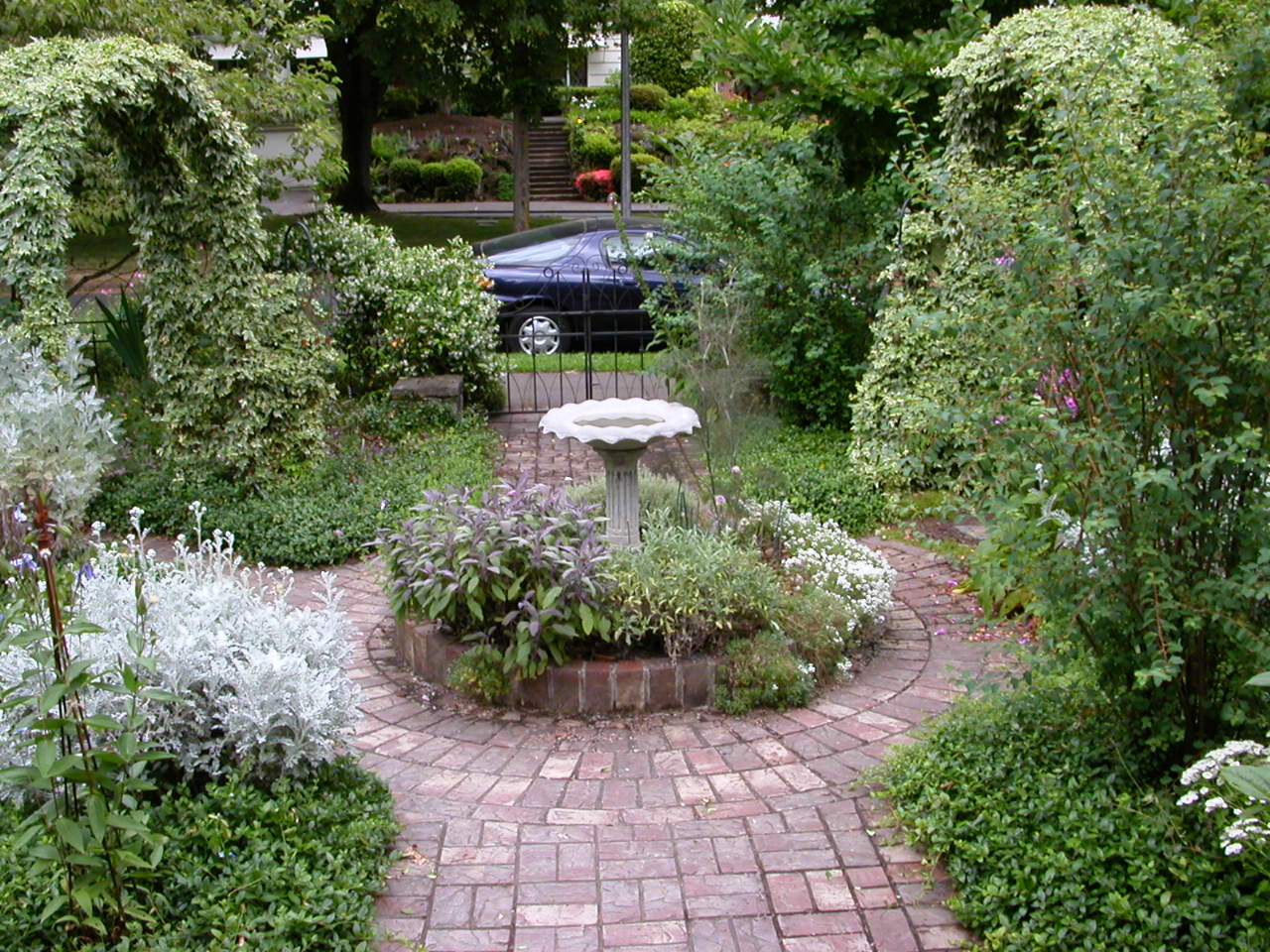
What has become of the charming border of pinks, lavender, and alyssum we once had? Whither the wisteria and evergreen clematis? What of the frothy shore of maidenhair ferns beneath the rhododendrons? What about the elegantly pruned ivy arches in the front garden?

Growth and simplification are forces that have been shaping the garden. The small magnolia of ten years ago is working hard at becoming a majestic tree, reaching at least 30 feet so far. It began to crowd and overshadow the ivy arches, which were also a great nuisance to keep trimmed. Growth and simplification - out came the ivy. Pruning issues led to the removal of the wisteria and the evergreen clematis. Ours is a small garden and rampant growth overwhelms it. The maidenhair ferns? The neighbors cut down a densely-shading tree, opening that part of the garden to full sun. As they say, if life gives you lemons, make lemonade! The fussy little border of pinks gave way to a more easy-going look, as the focus moved to our rose arbor. The peony whose flowers drooped on weak stems at any rain, the roses that attracted fungus, plants that grew gawky or died, were replaced by new favorites. We moved shrubs and flowers as they outgrew their spot or asked for better light.
Tim and I have learned to welcome the chance of rethinking parts of our garden. Each time, what appeared to be a problem became an opportunity. Some corner of the garden would undergo a renewal or acquire an identity it had lacked. It is a blessing I would do well to remember.
What has become of the charming border of pinks, lavender, and alyssum we once had? Whither the wisteria and evergreen clematis? What of the frothy shore of maidenhair ferns beneath the rhododendrons? What about the elegantly pruned ivy arches in the front garden?
Tim and I have learned to welcome the chance of rethinking parts of our garden. Each time, what appeared to be a problem became an opportunity. Some corner of the garden would undergo a renewal or acquire an identity it had lacked. It is a blessing I would do well to remember.
Subscribe to:
Posts (Atom)
